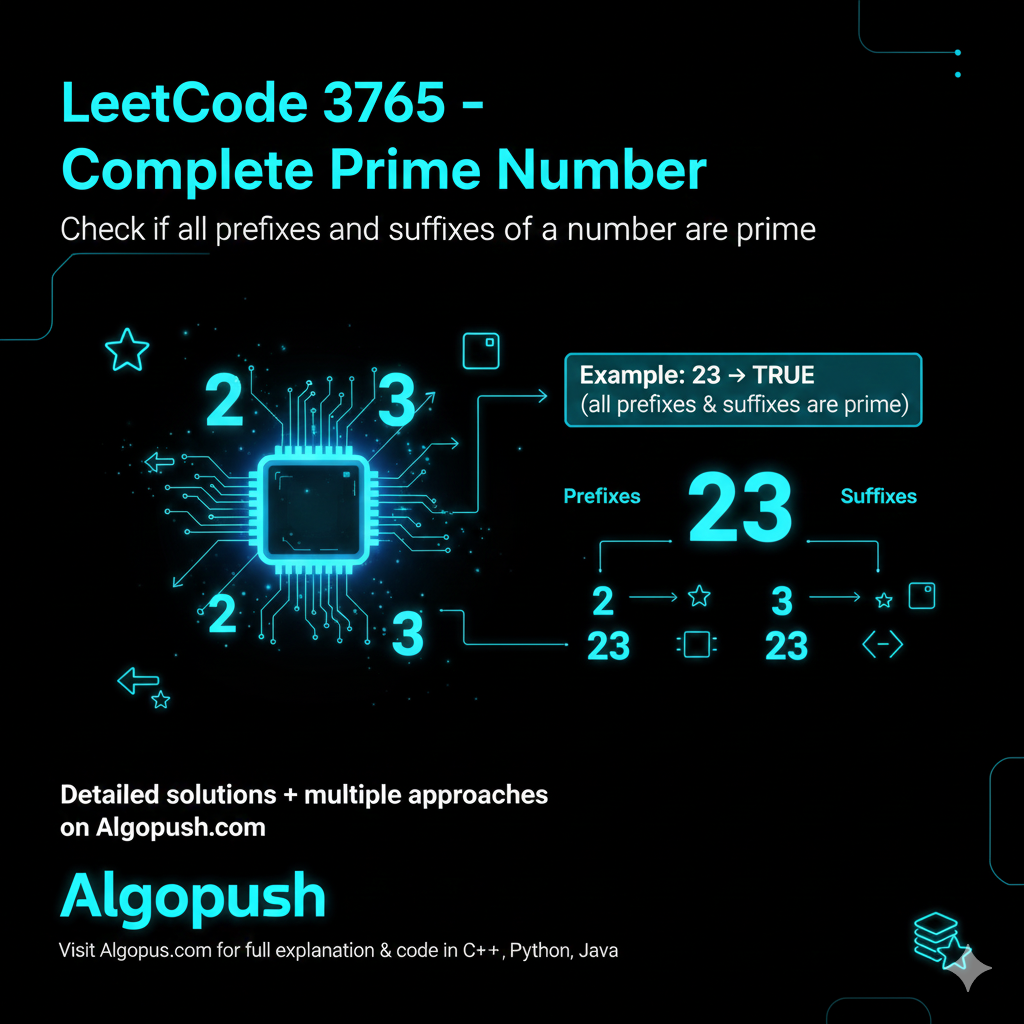
Complete Prime Number
Problem Statement
Given an integer num, return true if it is a complete prime,
otherwise return false. A complete prime is a number where every prefix and every
suffix of its decimal representation is a prime number.
Example 1
Input: num = 233
Output: true
Explanation: Prefixes: 2, 23, 233 (all prime). Suffixes: 3, 33, 233 (all prime).
Example 2
Input: num = 19
Output: false
Explanation: Prefix 1 is not prime. Suffix 9 is not prime.
Example 3
Input: num = 5
Output: true
Explanation: Single digit prime number.
Key Insight
The solution relies on these crucial observations:
- A number is a complete prime if ALL its prefixes and suffixes are prime numbers
- Single-digit numbers must be prime (2, 3, 5, 7)
- Prefixes are formed from left to right, suffixes from right to left
- The same number may appear as both prefix and suffix (the full number)
- We can optimize by memoizing prime checks to avoid redundant computations
Approach 1: Naive Prefix-Suffix Check (Your Approach)
Check all prefixes and suffixes independently by converting substrings to integers and testing primality.
Algorithm Steps
- Convert number to string for easy substring operations
- Check all prefixes from left to right:
- Take substring from index 0 to i (inclusive)
- Convert to integer and check primality
- If any prefix is not prime, return false
- Check all suffixes from right to left:
- Take substring from index i to end
- Convert to integer and check primality
- If any suffix is not prime, return false
- If all checks pass, return true
Complexity Analysis
| Time Complexity | Space Complexity |
|---|---|
| O(n²√M) | O(1) |
Where n is number of digits and M is the maximum number value. Each primality test takes O(√num) time.
class Solution {
public:

    bool isPrime(int num) {
        if (num <= 1) return false;
        if (num == 2) return true;
        if (num % 2 == 0) return false;

        for (int i = 3; i * i <= num; i += 2) {
            if (num % i == 0) return false;
        }
        return true;
    }

    bool completePrime(int num) {
        string s = to_string(num);
        int n = s.length();

        // Check all prefixes
        string prefix = "";
        for (int i = 0; i < n; i++) {
            prefix += s[i];
            int val = stoi(prefix);
            if (!isPrime(val)) return false;
        }

        // Check all suffixes
        string suffix = "";
        for (int i = n - 1; i >= 0; i--) {
            suffix = s[i] + suffix;
            int val = stoi(suffix);
            if (!isPrime(val)) return false;
        }

        return true;
    }
};
class Solution {
private boolean isPrime(int num) {
if (num <= 1) return false;
if (num == 2) return true;
if (num % 2 == 0) return false;
for (int i = 3; i * i <= num; i += 2) {
if (num % i == 0) return false;
}
return true;
}
public boolean completePrime(int num) {
String s = Integer.toString(num);
int n = s.length();
// Check all prefixes
StringBuilder prefix = new StringBuilder();
for (int i = 0; i < n; i++) {
prefix.append(s.charAt(i));
int val = Integer.parseInt(prefix.toString());
if (!isPrime(val)) return false;
}
// Check all suffixes
StringBuilder suffix = new StringBuilder();
for (int i = n - 1; i >= 0; i--) {
suffix.insert(0, s.charAt(i));
int val = Integer.parseInt(suffix.toString());
if (!isPrime(val)) return false;
}
return true;
}
}class Solution:
def isPrime(self, num: int) -> bool:
if num <= 1:
return False
if num == 2:
return True
if num % 2 == 0:
return False
for i in range(3, int(num**0.5) + 1, 2):
if num % i == 0:
return False
return True
def completePrime(self, num: int) -> bool:
s = str(num)
n = len(s)
# Check all prefixes
prefix = ""
for i in range(n):
prefix += s[i]
if not self.isPrime(int(prefix)):
return False
# Check all suffixes
suffix = ""
for i in range(n - 1, -1, -1):
suffix = s[i] + suffix
if not self.isPrime(int(suffix)):
return False
return TrueApproach 2: Memoized Prime Checks
Use memoization (caching) to avoid redundant prime number checks for the same value.
Algorithm Steps
- Create a memoization map/dictionary to store prime check results
- Convert number to string for substring operations
- Generate all unique prefixes and suffixes
- For each unique number, check primality using memoized function
- Return false if any check fails, otherwise return true
Complexity Analysis
| Time Complexity | Space Complexity |
|---|---|
| O(k√M) | O(k) |
Where k is number of unique prefixes/suffixes (≤ 2n) and M is maximum number value.
class Solution {
public:

    unordered_map<int, bool> memo;

    bool isPrime(int num) {
        if (memo.find(num) != memo.end()) {
            return memo[num];
        }

        if (num <= 1) {
            memo[num] = false;
            return false;
        }
        if (num == 2) {
            memo[num] = true;
            return true;
        }
        if (num % 2 == 0) {
            memo[num] = false;
            return false;
        }

        for (int i = 3; i * i <= num; i += 2) {
            if (num % i == 0) {
                memo[num] = false;
                return false;
            }
        }

        memo[num] = true;
        return true;
    }

    bool completePrime(int num) {
        string s = to_string(num);
        int n = s.length();

        unordered_set<int> numbersToCheck;

        // Collect all prefixes
        string prefix = "";
        for (int i = 0; i < n; i++) {
            prefix += s[i];
            numbersToCheck.insert(stoi(prefix));
        }

        // Collect all suffixes
        string suffix = "";
        for (int i = n - 1; i >= 0; i--) {
            suffix = s[i] + suffix;
            numbersToCheck.insert(stoi(suffix));
        }

        // Check all unique numbers
        for (int number : numbersToCheck) {
            if (!isPrime(number)) {
                return false;
            }
        }

        return true;
    }
};
import java.util.*;
class Solution {
private Map<Integer, Boolean> memo = new HashMap<>();
private boolean isPrime(int num) {
if (memo.containsKey(num)) {
return memo.get(num);
}
if (num <= 1) {
memo.put(num, false);
return false;
}
if (num == 2) {
memo.put(num, true);
return true;
}
if (num % 2 == 0) {
memo.put(num, false);
return false;
}
for (int i = 3; i * i <= num; i += 2) {
if (num % i == 0) {
memo.put(num, false);
return false;
}
}
memo.put(num, true);
return true;
}
public boolean completePrime(int num) {
String s = Integer.toString(num);
int n = s.length();
Set<Integer> numbersToCheck = new HashSet<>();
// Collect all prefixes
StringBuilder prefix = new StringBuilder();
for (int i = 0; i < n; i++) {
prefix.append(s.charAt(i));
numbersToCheck.add(Integer.parseInt(prefix.toString()));
}
// Collect all suffixes
StringBuilder suffix = new StringBuilder();
for (int i = n - 1; i >= 0; i--) {
suffix.insert(0, s.charAt(i));
numbersToCheck.add(Integer.parseInt(suffix.toString()));
}
// Check all unique numbers
for (int number : numbersToCheck) {
if (!isPrime(number)) {
return false;
}
}
return true;
}
}class Solution:
def __init__(self):
self.memo = {}
def isPrime(self, num: int) -> bool:
if num in self.memo:
return self.memo[num]
if num <= 1:
self.memo[num] = False
return False
if num == 2:
self.memo[num] = True
return True
if num % 2 == 0:
self.memo[num] = False
return False
for i in range(3, int(num**0.5) + 1, 2):
if num % i == 0:
self.memo[num] = False
return False
self.memo[num] = True
return True
def completePrime(self, num: int) -> bool:
s = str(num)
n = len(s)
numbers_to_check = set()
# Collect all prefixes
prefix = ""
for i in range(n):
prefix += s[i]
numbers_to_check.add(int(prefix))
# Collect all suffixes
suffix = ""
for i in range(n - 1, -1, -1):
suffix = s[i] + suffix
numbers_to_check.add(int(suffix))
# Check all unique numbers
for number in numbers_to_check:
if not self.isPrime(number):
return False
return TrueApproach 3: Optimized Early Exit with Set
Combine prefix and suffix checking with early exit and use a set to track checked numbers.
Algorithm Steps
- Convert number to string
- Use a set to track numbers that have been checked
- Check prefixes first, exiting early if any fail
- Then check suffixes, using memoized results when available
- Return true only if all checks pass
Complexity Analysis
| Time Complexity | Space Complexity |
|---|---|
| O(n√M) | O(n) |
Where n is number of digits and M is maximum number value.
class Solution {
public:

    bool isPrime(int num) {
        if (num <= 1) return false;
        if (num == 2 || num == 3) return true;
        if (num % 2 == 0 || num % 3 == 0) return false;

        // 6k ± 1 optimization
        for (int i = 5; i * i <= num; i += 6) {
            if (num % i == 0 || num % (i + 2) == 0) {
                return false;
            }
        }
        return true;
    }

    bool completePrime(int num) {
        string s = to_string(num);
        int n = s.length();

        unordered_set<int> checked;

        // Check prefixes with early exit
        for (int i = 0; i < n; i++) {
            int prefix = stoi(s.substr(0, i + 1));
            if (checked.find(prefix) == checked.end()) {
                if (!isPrime(prefix)) return false;
                checked.insert(prefix);
            }
        }

        // Check suffixes with early exit and reuse checked results
        for (int i = n - 1; i >= 0; i--) {
            int suffix = stoi(s.substr(i));
            if (checked.find(suffix) == checked.end()) {
                if (!isPrime(suffix)) return false;
                checked.insert(suffix);
            }
        }

        return true;
    }
};
import java.util.*;
class Solution {
private boolean isPrime(int num) {
if (num <= 1) return false;
if (num == 2 || num == 3) return true;
if (num % 2 == 0 || num % 3 == 0) return false;
// 6k ± 1 optimization
for (int i = 5; i * i <= num; i += 6) {
if (num % i == 0 || num % (i + 2) == 0) {
return false;
}
}
return true;
}
public boolean completePrime(int num) {
String s = Integer.toString(num);
int n = s.length();
Set<Integer> checked = new HashSet<>();
// Check prefixes with early exit
for (int i = 0; i < n; i++) {
int prefix = Integer.parseInt(s.substring(0, i + 1));
if (!checked.contains(prefix)) {
if (!isPrime(prefix)) return false;
checked.add(prefix);
}
}
// Check suffixes with early exit and reuse checked results
for (int i = n - 1; i >= 0; i--) {
int suffix = Integer.parseInt(s.substring(i));
if (!checked.contains(suffix)) {
if (!isPrime(suffix)) return false;
checked.add(suffix);
}
}
return true;
}
}class Solution:
def isPrime(self, num: int) -> bool:
if num <= 1:
return False
if num == 2 or num == 3:
return True
if num % 2 == 0 or num % 3 == 0:
return False
# 6k ± 1 optimization
i = 5
while i * i <= num:
if num % i == 0 or num % (i + 2) == 0:
return False
i += 6
return True
def completePrime(self, num: int) -> bool:
s = str(num)
n = len(s)
checked = set()
# Check prefixes with early exit
for i in range(n):
prefix = int(s[:i + 1])
if prefix not in checked:
if not self.isPrime(prefix):
return False
checked.add(prefix)
# Check suffixes with early exit and reuse checked results
for i in range(n - 1, -1, -1):
suffix = int(s[i:])
if suffix not in checked:
if not self.isPrime(suffix):
return False
checked.add(suffix)
return TrueEdge Cases and Testing
1. Single Digit Numbers
Input: 2 → Output: true (prime)
Input: 4 → Output: false (not prime)
Input: 1 → Output: false (not prime)
2. Two Digit Numbers
Input: 23 → Output: true (prefixes: 2,23; suffixes: 3,23 - all prime)
Input: 29 → Output: true (prefixes: 2,29; suffixes: 9,29 - 9 not prime → false)
Input: 19 → Output: false (prefix 1 not prime)
3. Three Digit Numbers
Input: 233 → Output: true (all prefixes and suffixes prime)
Input: 237 → Output: false (suffix 37 prime, but 7 prime, 237 not prime? Let's check)
Actually: Prefixes: 2,23,237 (237 not prime → false)
Suffixes: 3,37,237 (237 not prime → false)
4. Numbers with Repeated Digits
Input: 373 → Output: true
Prefixes: 3,37,373 (all prime)
Suffixes: 3,73,373 (all prime)

Input: 777 → Output: false
Prefixes: 7,77,777 (77 not prime, 777 not prime)
5. Large Numbers
Input: 233993 → Output: true
Prefixes: 2,23,233,2339,23399,233993 (all prime)
Suffixes: 3,93,993,3993,33993,233993 (need to check each)Detailed Explanation
The problem requires checking if a number is a "complete prime" - meaning ALL its prefixes and ALL its suffixes must be prime numbers.
For the number 233993:
- Prefixes: 2, 23, 233, 2339, 23399, 233993
- Suffixes: 3, 93, 993, 3993, 33993, 233993
- All must be prime for the number to be a complete prime
The key challenge is efficiently checking primality for potentially many numbers. We can optimize by:
- Memoization: Store results of primality tests to avoid redundant computations
- Early Exit: Return false as soon as any prefix or suffix fails the prime test
- Optimized Primality Test: Use 6k ± 1 optimization to check fewer divisors
- Set Usage: Track already checked numbers to avoid duplicate checks
The most efficient approach (Approach 3) combines all these optimizations:
- Uses 6k ± 1 optimization for faster primality testing
- Implements early exit when any check fails
- Uses a set to avoid redundant prime checks
- Processes prefixes and suffixes separately for clarity
FAQs
1. What is the definition of a complete prime?
A complete prime is a number where every prefix (substring starting from the first digit) and every suffix (substring ending at the last digit) of its decimal representation is a prime number.
2. Is 1 considered a prime number in this problem?
No, 1 is not considered a prime number. According to standard mathematical definition, a prime number must be greater than 1 and have exactly two distinct positive divisors: 1 and itself.
3. What is the time complexity of the primality test?
The basic primality test has time complexity O(√n) where n is the number being tested. The optimized 6k ± 1 version reduces the constant factor but remains O(√n).
4. Why use memoization for prime checks?
Memoization avoids redundant primality tests for the same number. For example, the full number appears as both a prefix and suffix, and smaller numbers may appear multiple times in different contexts.
5. What is the 6k ± 1 optimization for primality testing?
All prime numbers greater than 3 can be expressed in the form 6k ± 1. This optimization checks divisibility only by numbers of this form, reducing the number of checks by about 2/3 compared to checking all numbers up to √n.
6. Can leading zeros appear in prefixes or suffixes?
No, since we're converting substrings to integers, leading zeros are automatically removed. For example, "01" becomes 1, which would then be tested for primality.
7. What is the maximum number of digits we need to handle?
The problem constraints typically limit numbers to 32-bit integers (up to 2,147,483,647 or about 10 digits). However, our solutions work for any integer that fits in the language's integer type.
8. How does early exit improve performance?
Early exit means we stop checking as soon as we find any prefix or suffix that is not prime. This can significantly reduce the number of primality tests needed, especially for numbers that fail early.
9. Are there any known complete primes?
Yes, some known complete primes include: 2, 3, 5, 7, 23, 37, 53, 73, 373, 233993, etc. The sequence is finite and known as "truncatable primes" in mathematics.
10. What's the difference between prefix and suffix in this context?
Prefix: Substring starting from the first digit (e.g., for 2357: 2, 23, 235, 2357). Suffix: Substring ending at the last digit (e.g., for 2357: 7, 57, 357, 2357). Both must be prime for a complete prime.